Low A1C Results And What They Can Mean
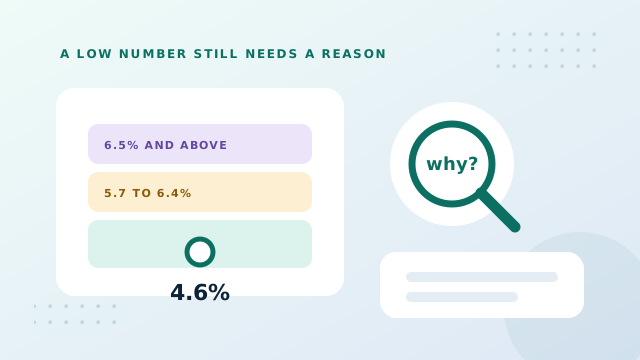
Almost everything written about the A1C concerns results that are too high. A number at the other end of the scale gets far less attention, and is usually assumed to be good news. Often it is. Sometimes it is the most informative result on the report, and reading it as a success means missing what it is actually saying.
What counts as low
There is no formal threshold below which a result is abnormal in the way 6.5 marks a threshold above. Most adults without diabetes sit somewhere between roughly 4.5 and 5.6 percent, and a figure inside that span usually needs no explanation at all.
| A1C | eAG mg/dL | eAG mmol/L | Usual reading |
|---|---|---|---|
| 5.5% | 111 | 6.2 | Unremarkable |
| 5.0% | 97 | 5.4 | Unremarkable |
| 4.6% | 85 | 4.7 | Low end of usual |
| 4.2% | 74 | 4.1 | Unusual, worth a reason |
| 4.0% | 68 | 3.8 | Unusual, worth a reason |
Context does more work than the figure. The same 5.0 percent means one thing in somebody with no diagnosis and quite another in somebody taking medication that can cause hypoglycemia.
The two questions a low result raises
Every low reading has one of two explanations, and they lead in opposite directions.
Is the glucose genuinely low?
If average glucose really is running low, the important question is why, and whether it involves episodes of hypoglycemia. That matters most for anybody using insulin or a medication that can drive glucose down, because a falling A1C in that situation can be produced by frequent lows rather than by improved stability.
This is one of the clearest limitations of an average. Lows and highs cancel arithmetically, so a run of hypoglycemic episodes can pull a percentage into what looks like an excellent range. Our guide on time in range explains how sensor data exposes what the average conceals.
Or is the measurement being pulled down?
Several situations shorten the average life of a red blood cell or change the population being measured, and every one of them lowers the percentage without glucose having moved.
| Situation | Mechanism |
|---|---|
| Recent blood loss or donation | A wave of young replacement cells carrying little coating |
| Blood transfusion | Donor cells carry someone else's history |
| Hemolytic anemia | Cells destroyed faster than usual |
| Pregnancy | Expanded volume and faster turnover |
| Advanced liver disease | Altered cell survival and glucose handling |
| Some kidney conditions and their treatment | Changed red cell production |
| Certain hemoglobin variants | Some assays under read the variant |
| Recently started iron or B12 treatment | A burst of new cell production |
Our guide on factors affecting A1C results goes through the mechanisms in more depth, including the ones that push in the opposite direction.
When a falling result deserves a closer look
A number moving downward is usually welcome. Three patterns are worth a second glance rather than a celebration.
- It fell faster than the treatment can explain. A drop of more than a point between two consecutive tests, without a corresponding change, invites a question about what else changed.
- Your daily readings disagree. If meter or sensor figures sit noticeably higher than the converted average, something may be pulling the measurement rather than the glucose. Our guide to estimated average glucose covers how to make that comparison fairly.
- You are experiencing lows. Shakiness, sweating, confusion, waking overnight, or unexplained tiredness in the hours after a meal. These matter regardless of what any percentage says, and they change what a sensible target looks like. See A1C target goals.
Low results without diabetes
For somebody with no diagnosis and no relevant medication, a result of 4.8 or 5.0 percent generally requires no thought at all. It sits within ordinary human variation. A figure well below that, particularly a new one where earlier results were higher, is usually investigated for a cause on the list above rather than treated as an achievement.
The honest summary is that a low A1C is not a score to be maximised. Below the point where average glucose is genuinely comfortable, further reductions stop representing anything useful and start representing either a measurement artefact or instability.
What to do with an unexpectedly low result
Keep it, date it, and put a note beside it. A single low value inside an otherwise consistent record is precisely the kind of entry that explains a puzzling pattern two years later, and deleting it because it looks wrong destroys the evidence.
The history mode of the calculator keeps every entry with its collection date and note, and our guide on building a trend chart explains why outliers are worth preserving.
Conclusion: Low A1C Results
A low result means either that average glucose really is low, or that something is pulling the measurement down. The first case matters most for anybody whose treatment can cause hypoglycemia, because lows and highs cancel inside an average. The second case includes blood loss, transfusion, hemolysis, pregnancy, liver and kidney conditions and some hemoglobin variants. Neither reading makes a low number automatically good news.
Record it with a note rather than discarding it, and compare it against your own daily readings.