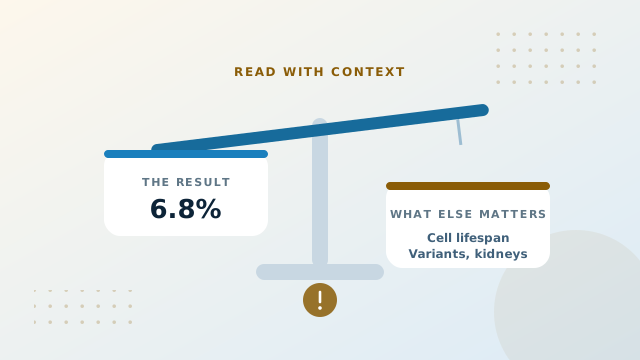
Factors Affecting A1C Test Results
The A1C test rests on one quiet assumption, that your red blood cells live a fairly typical length of time. When that assumption bends, the result drifts away from what your daily readings would suggest. None of the situations below make a result worthless. They mean it deserves interpretation rather than a straight reading.
Why cell lifespan changes everything
The test reports a proportion, not an amount. It asks what share of circulating hemoglobin carries attached glucose. Change the population of cells being measured and the answer changes, even when the glucose in your bloodstream has not moved at all.
Cells that survive longer than usual spend more time accumulating coating, which pushes the percentage upward. Cells replaced sooner than usual carry less, pulling it down. Our guide on how to read your result explains the underlying mechanism in more detail.
The main factors, and which way they push
| Situation | Typical effect | Reason |
|---|---|---|
| Iron deficiency anemia | Reads higher | Cells survive longer than usual |
| Recent blood loss or donation | Reads lower | A wave of young replacement cells |
| Blood transfusion | Unreliable | Donor cells carry a stranger's history |
| Pregnancy | Reads lower | Expanded volume and faster turnover |
| Reduced kidney function | Either direction | Altered cell survival and handling |
| Liver conditions | Either direction | Changed turnover and glucose handling |
| Hemoglobin variants | Method dependent | Some assays misread the variant |
| Certain medications | Either direction | Effects on cell production or the assay |
Looking at each one
Anemia and blood loss
Different anemias push in different directions, which is why the label alone does not tell you what to expect. Iron deficiency tends to lengthen cell survival and raise the reading. Anemias involving faster destruction of cells do the opposite. Recent blood loss, a donation, or surgery all trigger a burst of new cell production, and those young cells dilute the measured percentage for weeks afterward.
Pregnancy
Blood volume expands considerably and red cell turnover speeds up, both of which tend to lower an A1C relative to actual glucose levels. Care during pregnancy normally leans on other measures for exactly this reason, and results should always be read against guidance written specifically for that situation.
Kidney and liver conditions
Both organs influence how long red blood cells survive and how the body handles glucose. Reduced kidney function in particular is well recognised as a source of unreliable values, and the direction of the error depends on the individual circumstances rather than following a fixed rule.
Hemoglobin variants
Some people carry inherited variations in the structure of their hemoglobin. Certain laboratory methods struggle to measure A1C accurately when a variant is present, and results can come back noticeably higher or lower than expected. Where a variant is known, laboratories can often switch to a method that handles it correctly, so mentioning family background is genuinely useful.
Medication and supplements
Certain medications influence red blood cell production or glucose handling, and a few have been reported to interfere with particular assays. This is never a reason to stop taking anything. It is a reason to make sure whoever interprets the result holds the full list of what you take.
Illness and prolonged stress
Short episodes barely register, which is one of the strengths of a three month average. Prolonged illness is a different matter and can shift the picture enough to be worth noting alongside the result.
If your A1C and your meter readings consistently disagree by a wide margin, that gap is itself worth raising. It is a recognised prompt to look at method and context rather than something to explain away.
What to do with this information
The purpose here is context rather than doubt. A result affected by one of these factors is still useful, it simply needs to be read alongside the reason.
- Record the context at the time. The note field in the calculator travels through to the printed report, giving whoever reads it the surrounding detail rather than a bare number.
- Keep the outlier. Deleting a result that looks wrong removes the very evidence that would explain it later.
- Mention a laboratory change. Methods vary slightly between providers, and that alone can explain a small step.
- Compare against your own readings. A converted eAG figure sitting far from your meter average is the clearest early signal something is worth investigating.
Our guide to estimated average glucose explains how to make that comparison fairly, while reading your A1C result shows how to bring the surrounding context into the conversation.
Conclusion: Factors Affecting A1C
An A1C measures a proportion of a moving population of cells. Anything that changes how long those cells live, or how a machine reads them, moves the answer. Anemia, blood loss, transfusion, pregnancy, kidney and liver conditions, hemoglobin variants and some medications are the usual candidates.
None of that makes the test unreliable in general. It makes context part of the reading. Record yours alongside each result and the pattern stays interpretable for years. See the full position on our medical disclaimer page.