How Often Should You Get An A1C Test
Testing frequency is decided by the person managing your care, but the logic behind the usual intervals is worth understanding, because it explains why a repeat test six weeks after the last one rarely tells anybody anything useful.
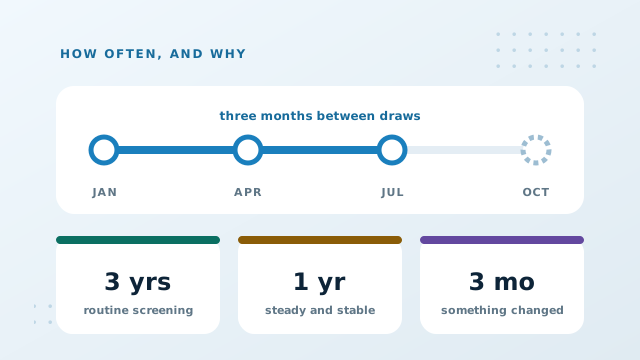
Why three months is the floor
The test measures the glucose coating carried by circulating red blood cells, and those cells live for roughly three months. At any moment your bloodstream holds a mixture of new, middle aged and old cells, so the result is a weighted average across that span.
Retesting after four weeks therefore re-measures a population of cells that is largely the same one measured last time. Most of the value has not yet turned over. The two results will look similar because they are describing overlapping evidence, not because nothing has changed.
A rough guide to what a fresh result actually reflects: about half of it comes from the most recent month, roughly a quarter from the month before that, and the remainder from the month before that again. Recent effort counts most, but it never counts alone.
The usual intervals
Guidance varies between countries and between clinical situations, but the shape below is broadly consistent.
| Situation | Typical interval | Why |
|---|---|---|
| Routine screening, normal result | Every 3 years | Low prior probability of rapid change |
| Result inside the prediabetes band | Every year | Watching for direction of travel |
| Diagnosed, stable, at target | Every 6 months | Confirming things are holding |
| Diagnosed, above target | Every 3 months | The shortest gap that produces new information |
| Treatment or dose recently changed | About 3 months later | Long enough for the change to register |
| Confirming a first abnormal result | Promptly | Confirmation, not trend |
That final row is the exception that proves the rule. A confirmation test is not asking whether anything has changed, it is asking whether the first result was correct, so the usual waiting period does not apply.
What shortens the interval
Several circumstances make more frequent testing worthwhile, and most of them share one feature: something has changed that the previous result could not have captured.
- A new medication or a dose adjustment. The next test measures whether the change did what was intended.
- A result that moved unexpectedly. An out of pattern reading is often repeated before anything is concluded from it.
- Pregnancy, or planning one. Monitoring during pregnancy runs on entirely separate guidance. See our guide on A1C during pregnancy.
- A period of illness, surgery or hospital admission. Both glucose and cell turnover can shift substantially.
- A deliberate change in routine. If you have altered how you eat, move or sleep, a test three months later measures whether it worked.
What lengthens it
Testing more often is not automatically better. A stable result at target, no medication changes, and no new symptoms all point towards a longer gap. Extra tests in that situation mostly produce noise, and noise invites people to react to movements that are not real.
There is also the question of whether an A1C is the right instrument at all. Someone using a continuous sensor already has a far richer picture of daily glucose, which is why time in range and the glucose management indicator increasingly sit alongside the laboratory value rather than behind it.
Keeping the interval visible in your own record
The gap between two readings changes how you should interpret the difference between them. A fall of 0.4 points across three months and the same fall across two years describe very different rates of change.
This is why the history mode of the calculator asks for a collection date with every entry rather than just an order. Plotted against a real timeline, three results clustered in one season look quite different to three spread across two years, even when the numbers are identical. Our guide on building a trend chart covers how to keep those dates accurate.
| Readings | Spread over 9 months | Spread over 3 years |
|---|---|---|
| 7.4% → 7.0% → 6.7% | A clear recent improvement | A very gradual drift |
A note on testing too often
Some people order repeat tests privately every few weeks, hoping to see progress sooner. What they usually see is the same figure wobbling by a tenth or two, which is assay variation rather than movement. It is a reliable route to unnecessary worry. If you want faster feedback, daily glucose readings are the tool designed for it, and the A1C is what confirms the pattern months later.
Conclusion: A1C Testing Frequency
Three months is the shortest gap that yields genuinely new information, because that is roughly how long it takes for the measured population of red blood cells to turn over. Routine screening runs on years, a raised result usually on a year, and active management on three to six months. A confirmation test is the one case where waiting does not apply.
Record each result with its collection date so the gap between readings stays part of the story.