A1C To Blood Sugar Conversion Step By Step
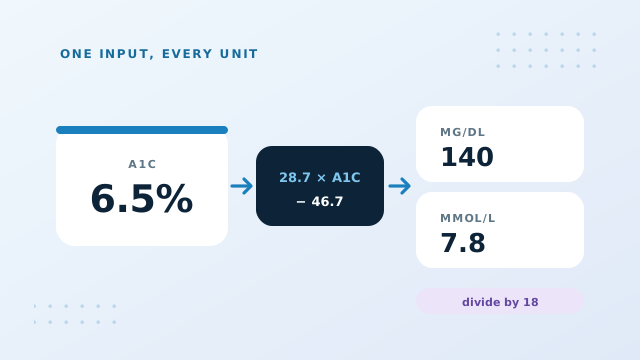
An A1C to blood sugar conversion takes one percentage and returns the average glucose it corresponds to. The calculator on this site does it instantly, but knowing how to run the arithmetic yourself is genuinely useful, because it lets you sanity check a figure, work from a report while offline, and understand what the tool is actually doing.
The one calculation you need
Everything here follows from a single straight line derived from a study of volunteers wearing continuous glucose monitors. It has one form and two directions.
Forward: average glucose in mg/dL equals 28.7 multiplied by the A1C, minus 46.7.
Reverse: A1C equals the average glucose plus 46.7, divided by 28.7.
The order of operations decides the answer. Multiply first, subtract second. Doing it the other way round produces a figure that looks plausible and is entirely wrong.
A worked example, forward
Take a result of 6.8 percent.
- Multiply by 28.7. 6.8 times 28.7 is 195.16.
- Subtract 46.7. That leaves 148.46, which displays as 148 mg/dL.
- Divide by eighteen for millimoles. 148.46 divided by 18 is 8.25, which displays as 8.2 mmol/L.
Note that the millimole figure is calculated from the unrounded number, not from the rounded 148. Working from the rounded value here would give 8.2 as well, but at other points on the scale the two routes disagree in the last digit. The calculator always carries full precision internally and rounds only at the moment a figure appears.
A worked example, reverse
Now suppose your meter reports a fourteen day average of 172 mg/dL and you want the equivalent percentage.
- Add 46.7. 172 plus 46.7 is 218.7.
- Divide by 28.7. That gives 7.62, which displays as 7.6 percent.
- Working in millimoles? Multiply by eighteen first. An average of 9.6 mmol/L is 172.8 mg/dL, then follow the same two steps.
The unit conversion sitting underneath
Milligrams per decilitre and millimoles per litre measure the same substance on different scales. The bridge between them is a fixed number for glucose.
| Starting unit | Operation | Example in | Example out |
|---|---|---|---|
| mg/dL to mmol/L | Divide by 18 | 154 | 8.6 |
| mmol/L to mg/dL | Multiply by 18 | 7.8 | 140 |
| A1C to mg/dL | 28.7 × A1C − 46.7 | 7.0% | 154 |
| mg/dL to A1C | (mg/dL + 46.7) ÷ 28.7 | 183 | 8.0% |
The divisor of eighteen is specific to glucose. It comes from the molecular weight of the molecule, which is why a different substance on a laboratory report needs a different number entirely.
Two shortcuts worth memorising
You will rarely need the full arithmetic if you remember two anchors and one step size.
- 7.0 percent is about 154 mg/dL, or 8.6 mmol/L. This is the most useful anchor on the scale because so much guidance references it.
- Every 0.1 percentage point is worth about 2.9 mg/dL, or 0.16 mmol/L. From the anchor you can walk in either direction.
So 7.3 percent is three tenths above the anchor. Three times 2.9 is roughly 9, giving about 163 mg/dL. The exact answer is 163. Close enough for a mental check, and quick enough to do while reading a report.
Common conversion mistakes
Reading the percentage as a glucose value
An A1C of 7.0 does not mean a blood glucose of seven anything. In millimoles it is about 8.6 and in milligrams about 154. This is by far the most frequent error, and it happens most often to people who normally work in mmol/L, because 7.0 looks like a plausible glucose figure in that unit.
Subtracting before multiplying
Running 7.0 minus 46.7 and then multiplying gives a negative number, which at least announces itself. Doing the same at 8.5 produces something less obviously wrong. Multiply first.
Confusing an eAG with a meter average
A converted figure and a meter average are different things and will rarely match exactly. A meter average built mostly from pre-meal readings normally sits below the converted value, because the hours after eating are under sampled. A persistent wide gap is worth mentioning to a clinician rather than explaining away, and our guide on factors affecting A1C covers why the gap can open.
Using the wrong reporting scale
If your report shows a figure like 53 rather than 7.0, you are reading the IFCC scale in millimoles per mole. That needs its own conversion, covered in our guide to A1C in mmol/mol.
A quick reference for checking your own arithmetic
| A1C | mg/dL | mmol/L | Band |
|---|---|---|---|
| 5.5% | 111 | 6.2 | Below 5.7% |
| 6.0% | 126 | 7.0 | 5.7% to 6.4% |
| 6.5% | 140 | 7.8 | 6.5% and above |
| 7.0% | 154 | 8.6 | 6.5% and above |
| 8.0% | 183 | 10.2 | 6.5% and above |
| 9.0% | 212 | 11.8 | 6.5% and above |
The full A1C chart guide extends this across the whole scale, and the reference chart on the home page covers the intermediate steps.
Conclusion: A1C To Blood Sugar Conversion
One line does all the work. Multiply the percentage by 28.7, subtract 46.7, and you have an average glucose in mg/dL. Divide by eighteen for millimoles, or reverse the two steps to go from a glucose average back to a percentage. Remember the anchor at 7.0 percent and the step size of 2.9 mg/dL per tenth, and you can check any figure in your head.
Open the calculator to have all three units returned at once, at full precision.