A1C Levels In Children And Teenagers
A young person's A1C is read against a different backdrop to an adult's. The measurement is identical, the arithmetic is identical, but the circumstances around it change month to month in ways adult guidance never has to consider. Care is directed by a paediatric team, and this page is background for the family reading the report rather than instruction.
What is different about a growing body
Puberty raises insulin resistance
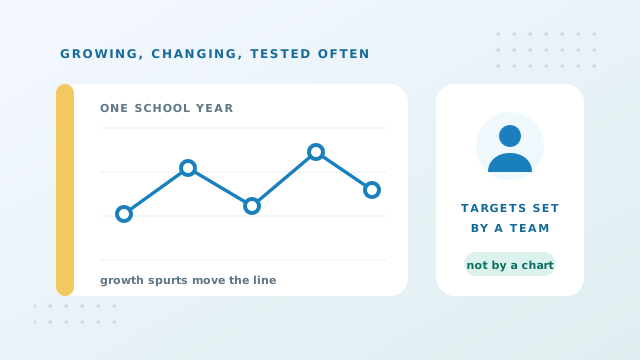
Growth hormone rises sharply through adolescence, and one of its effects is to reduce insulin sensitivity. Glucose requirements can climb substantially, and a teenager whose routine has not changed at all may see their A1C rise purely because their body has entered a new phase. Reading that rise as carelessness is both unfair and inaccurate.
Growth spurts arrive unevenly
Body size can change quickly, and with it the amount of insulin needed. What was correct three months ago may not be correct now, which is one reason paediatric appointments cluster more closely than adult ones.
The day has a fixed shape
School timetables set meal times, activity and the practical ability to check anything. A physical education lesson on a Tuesday afternoon is a recurring event with a recurring glucose effect, and patterns like that show up in an average without ever being visible in it.
Hypoglycemia carries different weight
Younger children may not recognise or report a low reliably, and a low at school is harder to manage than one at home. This shifts the balance of what a sensible target looks like, particularly for the very young.
Adult screening bands of 5.7 and 6.5 percent are drawn from adult population data. They are not the framework a paediatric team uses to judge a young person's result, and applying them at home usually produces worry rather than insight.
How targets are approached
Modern paediatric guidance has generally moved towards tighter targets than were common a generation ago, on the evidence that early control has long lasting benefit and that newer technology makes it achievable with less hypoglycemia. Many services work towards something below 7.0 percent for most young people, while individualising freely.
| Circumstance | Effect on the target |
|---|---|
| Using a sensor and modern insulin delivery | Tighter becomes safer |
| Reliable recognition of low glucose | Tighter is reasonable |
| Very young child | Caution about lows |
| History of severe hypoglycemia | Looser, deliberately |
| Limited support at school or home | Adjusted to what is workable |
The principle is the same one described in our guide to A1C target goals: the target follows the person and their circumstances rather than the other way round.
Reading a young person's trend without turning it into a verdict
An A1C is a number attached to a person who is thirteen and would rather be doing something else. How the result is discussed at home has consequences for whether the next one gets discussed at all.
- Expect variation through adolescence. A rise during a growth phase is physiology, not a report card.
- Look at the line, not the dot. One result carries far less information than four across a year.
- Record what was happening. Exams, illness, a growth spurt, a new device, a school trip. Context makes a chart interpretable later.
- Separate the number from the person. A result describes a bloodstream over three months. It does not describe effort, character or how much anybody cares.
- Keep the awkward results. The one that breaks the pattern usually holds the most information.
The history mode of the calculator plots dated results with a note beside each, and prints them as a single page that a young person can bring to an appointment themselves. Handing that over is a small piece of ownership, and it tends to matter more than the chart does. Our guide on building a trend chart covers the mechanics.
Where sensors change the conversation
Many young people now wear continuous glucose monitors, which shifts the emphasis away from a quarterly percentage and towards what the days look like. Time in range gives feedback within hours rather than months, which suits a teenager's timescale considerably better than a laboratory result three months away.
Our guides on time in range and the glucose management indicator explain the two figures that dominate a sensor report, and why neither replaces the laboratory test entirely.
Conclusion: A1C In Children And Teenagers
The test is the same, the context is not. Puberty raises insulin resistance, growth changes requirements unpredictably, school sets the shape of the day, and hypoglycemia carries extra weight when the person having it is small or at school. Adult screening bands do not apply. Targets come from a paediatric team, and a rising result during adolescence is often physiology rather than failure.
Keep a dated record with notes, and bring the printed page to the next appointment.