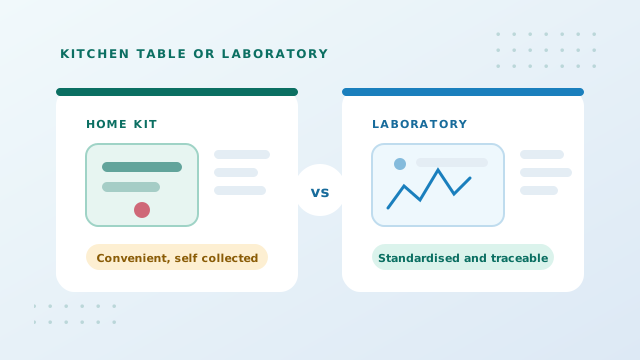
Home A1C Test Kits Compared With Lab Testing
Home A1C kits have become easy to buy and reasonably cheap. They are convenient, and for the right purpose they work. They also carry limitations that are easy to miss on the packaging, and knowing where those limits sit determines whether a self collected result is genuinely useful or quietly misleading.
The two kinds of kit
Products sold as home A1C tests fall into two categories that behave quite differently, and the box does not always make the distinction obvious.
Mail in collection kits
You collect a few drops of blood onto a card or into a small tube, post it to a partner laboratory, and receive a result a few days later. The measurement is performed by an actual laboratory on standard equipment. The main variable introduced by you is the quality of the sample.
Instant read cartridge kits
A fingerstick sample goes into a cartridge and a small reader returns a figure within minutes. Nothing is posted. These use the same broad technology as the point of care analysers found in many clinics, in a consumer package.
Both routes measure the same thing your laboratory measures. The difference lies in how tightly the process is controlled, not in what is being detected.
How they compare in practice
| Factor | Mail in kit | Instant kit | Laboratory draw |
|---|---|---|---|
| Who collects the sample | You | You | Trained staff |
| Typical wait for a result | Several days | Minutes | Hours to days |
| Method standardisation | Laboratory grade | Varies by product | Laboratory grade |
| Main source of error | Sample quality | Technique and storage | Well controlled |
| Goes into your medical record | Usually not automatically | No | Yes |
| Accepted for diagnosis | Generally no | No | Yes |
Where the accuracy question really sits
A well made kit measuring a well collected sample can return a figure close to what a laboratory would report. The problem is that both halves of that sentence have to hold, and the second one is under your control rather than a technician's.
- Sample volume. Too little blood on a collection card is the most common failure. It can produce a result rather than an error message, which is the dangerous version.
- Squeezing the finger. Milking a fingertip mixes tissue fluid into the sample and dilutes it.
- Time and temperature in transit. A card sitting in a hot postbox over a weekend is not the sample the laboratory expected.
- Cartridge storage. Instant kits contain reagents with real temperature limits and expiry dates. A cartridge stored in a bathroom cabinet for a year is not reliable.
- Reading the instructions once. Most technique errors are first attempt errors, and the first attempt is the one people act on.
None of this makes home testing pointless. It means a single home result carries wider uncertainty than a single laboratory result, and should be read with that in mind.
When a home kit is genuinely useful
- Between scheduled laboratory tests. If your clinic tests every six months and you want an interim read after changing something, a kit fills the gap.
- When access is difficult. Distance, mobility, work patterns and waiting lists are real barriers, and an approximate number beats no number.
- For personal trend keeping. Consistent use of the same product tends to produce consistent bias, which means the direction of travel across several results is still informative even if the absolute figure drifts.
When it should not stand alone
- For a diagnosis. Screening thresholds are built on standardised laboratory methods and a confirmation process. A home figure of 6.6 percent is a reason to book a test, not a diagnosis.
- When something might be skewing the measurement. Anemia, pregnancy, kidney conditions and hemoglobin variants all complicate interpretation, and a home device cannot flag any of them. See factors affecting A1C.
- When a treatment decision depends on it. Dose changes should rest on the number your clinical team can stand behind.
- When the result surprises you. An unexpected figure from a home kit is a prompt to repeat it properly, not to conclude anything.
Comparing a home result against a laboratory result taken weeks apart is not a fair test of the kit. The two samples describe overlapping but different periods. If you want to compare methods, the samples need to be close together in time.
Keeping both kinds of result in one record
A history that mixes sources is still worth keeping, provided the source is written down. The note field in the history mode of the calculator exists for exactly this, and it travels through to the printed report so that whoever reads it can see which figures came from where.
Labelling matters because a small step between two readings might be a genuine change or might be the difference between two methods. Without the note, that ambiguity is invisible a year later. Our guide on building a trend chart covers how to keep a record honest over time.
Conclusion: Home A1C Test Kits
Home kits measure the same thing a laboratory measures, but the sample passes through your hands rather than a technician's, and that widens the uncertainty around any single result. Use them for convenience, for interim reads and for trend keeping. Do not use them to diagnose, to make treatment decisions, or as the final word on a surprising number. Label every entry with its source.
Add your result with a note and the printed report will show where each figure came from.